Heavy Metal Concentrations and Health Risk Assessment of Cassava Cultivated with Variable Farming Conditions
DOI:
https://doi.org/10.60787/ijrti.vol2no2.4Keywords:
Niger Delta, Oil-contaminated soils, Inorganic fertilizer, Herbicides, Sun-dried cassava, Heavy metals, Health risk assessmentAbstract
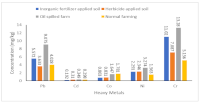
This study assesses the concentrations of heavy metals and associated health risks in sun-dried cassava harvested under four distinct farming conditions in the Niger Delta, Nigeria: normal (control), inorganic fertilizer-treated, herbicide-treated, and crude oil-polluted soils. Using validated digestion protocols and spectrophotometric analysis, levels of Lead (Pb), Cadmium (Cd), Cobalt (Co), Nickel (Ni), and Chromium (Cr) were quantified. Health risk indices such as Estimated Daily Intake (EDI), Target Hazard Quotient (THQ), Hazard Index (HI), Lifetime Cancer Risk (LCR), and Total Lifetime Cancer Risk (TLCR) were calculated for adult and child populations. Results showed that cassava from oil-polluted and chemically treated soils contained higher concentrations of heavy metals, often surpassing FAO/WHO permissible limits. THQ and HI values exceeded the safe threshold (HI > 1.0) in several samples, indicating potential non-carcinogenic health risks. LCR and TLCR values, especially for Cr and Ni, were highest in cassava from fertilizer and oilimpacted soils, exceeding the USEPA safety benchmark (1.0E–04), thus posing longterm carcinogenic risks. The study highlights the significant public health implications of current farming practices in ecologically fragile, oil-producing areas of Nigeria and calls for regulatory oversight, sustainable soil remediation, and community health awareness.Downloads
References
[1] FAO. (2023). Cassava statistics and production in Nigeria. Food and Agriculture Organization. https://www.fao.org/statistics
[2] Ofoegbu, C. J., Ogban, F. E., & Essien, B. A. (2022). Soil-metal-crop interactions in petroleum-impacted areas of Nigeria: Implications for public health. SN Applied Sciences, 4(10), 255. https://doi.org/10.1007/s42452-022-05163-7.
[3] Etim, E. E., Akpabio, U. S., & Umoh, A. A. (2021). Accumulation of heavy metals in cassava tubers cultivated in contaminated soils: A human health risk perspective. Environmental Challenges, 5, 100287. https://doi.org/10.1016/j.envc.2021.100287.
[4] Nduka, J. K., & Orisakwe, O. E. (2011). Water quality issues in the Niger Delta of Nigeria: A look at heavy metal levels and health implications. Environmental Science and Pollution Research, 18(2), 237–246. https://doi.org/10.1007/s11356-010-0379-4.
[5] UNEP. (2011). Environmental assessment of Ogoniland. United Nations Environment Programme. https://www.unep.org/exploretopics/disasters-conflicts/what-wedo/environmental-assessment-ogoniland
[6] Ololade, I. A., Ajayi, I. R., & Adefemi, S. O. (2010). Heavy metals in soil and cassava tubers from the vicinity of a cement factory in Nigeria. Journal of Environmental Chemistry and Ecotoxicology, 2(1), 1–9.
[7] Tijani, M. N., Onodera, S., & Ito, K. (2005). Chemical and isotopic signatures in groundwater from the basement complex terrain of southwestern Nigeria: Implications for water resources management. Journal of African Earth Sciences, 42(3), 189–204. https://doi.org/10.1016/j.jafrearsci.2005.10.001
[8] Aikpokpodion, P. E., Longe, E. O., & Ojeniyi, S. O. (2013). Heavy metals contamination in agricultural soils and uptake by cocoa plants in Cross River State, Nigeria. Journal of Environmental Chemistry and Ecotoxicology, 5(10), 284–291. https://doi.org/10.5897/JECE2013.0315.
[9] Ajayi, O., Oluwafemi, A., & Edema, M. O. (2022). Effect of processing on heavy metal content of cassava products in Nigeria. Food Control, 131, 108431. https://doi.org/10.1016/j.foodcont.2021.108431
[10] USEPA. (2011). Risk assessment guidance for superfund (RAGS): Volume I – Human Health Evaluation Manual (Part F, Supplemental
Guidance for Inhalation Risk Assessment). U.S. Environmental Protection Agency.
[11] WHO. (2017). Guidelines for drinking-water quality (4th ed.). World Health Organization. https://www.who.int/publications/i/item/97892
41549950
[12]Jarup, L. (2003). Hazards of heavy metal contamination. British Medical Bulletin, 68(1), 167–182. https://doi.org/10.1093/bmb/ldg032
[13] Tchounwou, P. B., Yedjou, C. G., Patlolla, A. K., & Sutton, D. J. (2012). Heavy metal toxicity and the environment. Experientia Supplementum, 101, 133–164. https://doi.org/10.1007/978-3-7643-8340-4_6
[14]Zhang, H., Ma, Y., & Liu, Z. (2020). Longterm exposure to dietary heavy metals: Implications for public health and food policy. Ecotoxicology and Environmental Safety, 197, 110601. https://doi.org/10.1016/j.ecoenv.2020.110601
[15] USEPA. (2022). Human Health Risk Assessment Protocol for Hazardous Waste Combustion Facilities (Final). United States Environmental Protection Agency. https://www.epa.gov/risk/human-health-riskassessment
[16] Chibuike, G. U., & Obiora, S. C. (2014). Heavy metal polluted soils: Effect on plants and bioremediation methods. Applied and
Environmental Soil Science, 2014, 752708. https://doi.org/10.1155/2014/752708
[17] Osu, C. I., & Onianwa, P. C. (2020). Assessment of heavy metal concentrations in cassava cultivated in oil-polluted soils in Nigeria. Environmental Monitoring and Assessment, 192(4), 254. https://doi.org/10.1007/s10661-020-8189-3
[18] Yusuf, A. A., Osibanjo, O., & Adebayo, A. O. (2020). Trace metal levels in tuber crops cultivated in a Nigerian industrial area: Risk assessment for consumers. Environmental Nanotechnology, Monitoring & Management, 14, 100348. https://doi.org/10.1016/j.enmm.2020.100348
[19] Rahman, M. M., Islam, M. R., & Haque, M. A. (2021). Determination of heavy metals in vegetables and health risk assessment in
Bangladesh. Toxicology Reports, 8, 686–695. https://doi.org/10.1016/j.toxrep.2021.03.010
[20] Bempah, C. K., Asomaning, J., Boateng, J., & Asabere, S. B. (2022). Assessment of heavy metals in cassava and soil from miningimpacted communities in Ghana. Environmental Monitoring and Assessment, 194, 224. https://doi.org/10.1007/s10661-022-09860-3
[21] Cui, Y., Zhang, H., & Li, Y. (2020). Bioaccumulation and transfer of heavy metals in soil–plant–human system: A case study of cassava in mining-impacted zones. Ecotoxicology and Environmental Safety, 192, 110273. https://doi.org/10.1016/j.ecoenv.2020.110273
[22] Zhuang, P., Li, Y., Zou, B., & McBride, M. B. (2021). Transfer of heavy metals from soils to vegetables in the Pearl River Delta, South China. Food Additives & Contaminants: Part B, 14(1), 34–46. https://doi.org/10.1080/19393210.2020.1824550
[23] USEPA. (2022). Regional Screening Level (RSL) Summary Table (May 2022). United States Environmental Protection Agency.
https://www.epa.gov/risk/regional-screeninglevels-rsls
[24] Ololade, I. A., Olatunji, A. S., Oresanya, O. O., & Lajide, L. (2021). Source identification and risk assessment of heavy metals in agricultural soils and food crops from oilpolluted areas of the Niger Delta, Nigeria. Environmental Geochemistry and Health, 43(1), 275–291.
[25] Essien, O. E., Antigha, R. E., & Onuk, E. G. (2019). Impact of crude oil pollution on soil and water and its human health implications in
Eket, Akwa Ibom State. Journal of Health and Pollution, 9(23), 1–7.
[26] Alloway, B. J. (2013). Heavy metals in soils: Trace metals and metalloids in soils and their bioavailability (3rd ed.). Springer Science &
Business Media.
[27] Latif, M. I., Khan, M. F., Rafiq, M., & Nasir, M. (2020). Interaction of herbicides with soil and their persistence: Environmental risk and
management. Environmental Science and Pollution Research, 27, 27654–27666.
[28] Akpoveta, O. V., Osakwe, S. A., Okoh, B. E., & Otuya, B. O. (2011). Physicochemical characteristics and levels of some heavy metals in soils around metal scrap dumps in some parts of Delta State, Nigeria. Journal of Applied Sciences and Environmental Management, 15(4), 597–600.
[29] Nwaichi, E. O., & Mbaka, G. O. (2015). Environmental risks of petroleum industry impact in the Niger Delta region of Nigeria: A review. Environmental Monitoring and Assessment, 187(11), 683.
[30] Ubuoh, E. A., Akamigbo, F. O. R., & Ukpaka, C. P. (2020). Distribution and ecological risk assessment of heavy metals in oilcontaminated soils in Gokana, Niger Delta Region, Nigeria. Environmental Earth Sciences, 79(5), 145.
[31] Hariyadi, Y., Damayanti, A., & Latifah, A. (2024). Influence of chemical fertilizers on yield and environmental risk in root crops: A soil health approach. Journal of Environmental Monitoring and Assessment, 196(2), 110.
[32] Whalley, W. R., Ober, E. S., & Jenkins, M. (2018). Measurement of the matric potential of soil water in the rhizosphere. Journal of Experimental Botany, 69(13), 3305–3315.
[33] Tóth, G., Hermann, T., Da Silva, M. R., & Montanarella, L. (2016). Heavy metals in agricultural soils of the European Union with implications for food safety. Environment International, 88, 299–309.
[34] Ogunkunle, C. O., Fatoba, P. O., & Bello, O. S. (2015). Comparative study of heavy metal concentrations in cassava cultivated on
petroleum-contaminated and uncontaminated soils. Toxicological & Environmental Chemistry, 97(8), 1097–1112.
[35] Babel, S., & Opiso, E. M. (2007). Removal of Cr from synthetic wastewater by sorption onto volcanic ash soil. International Journal of
Environment and Pollution, 30(3–4), 487–495.
[36] World Health Organization (WHO). (2011). Safety evaluation of certain contaminants in food: Prepared by the seventy-second meeting
of the Joint FAO/WHO Expert Committee on Food Additives (JECFA). WHO Food Additives Series, No. 63.
[37] Anoliefo, G. O., Edegbai, B. O., & Agho, M. O. (2006). Ecotoxicological effects of spent lubricating oil on the growth of Ceratotheca
sesamoides. Environmental Science: An Indian Journal, 1(1), 34–41.
[38] Agah, H., Leermakers, M., Elskens, M., Fatemi, S. M. R., & Baeyens, W. (2009). Accumulation of trace metals in the muscle and liver tissues of five fish species from the Persian Gulf. Environmental Monitoring and Assessment, 157(1–4), 499–514.
[39] Adewole, M. B., & Uchegbu, L. U. (2010). Properties of soils and plants uptake within the vicinity of selected automobile workshops in
Ile-Ife Southwestern Nigeria. African Journal of Environmental Science and Technology, 4(3), 65–71.
[40] Hariyadi, I., Salim, L. O., & Putri, Y. A. (2024). Effects of fertilizer dosage on nutrient uptake and yield of cassava in a tropical agroecosystem. Journal of Soil Science and Plant Nutrition, 24(1), 45–56.
[41] Yadav, S. K. (2010). Heavy metals toxicity in plants: An overview on the role of glutathione and phytochelatins in heavy metal stress
tolerance of plants. South African Journal of Botany, 76(2), 167–179.
[42] Whalley, W. R., To, J., Kay, R., Whitmore, A. P., & Lockwood, P. (2018). The importance of soil structure in crop production: A review. Soil and Tillage Research, 175, 34–42.
[43] Ogunlaja, A., & Adedapo, A. A. (2021). Assessment of soil microbial dynamics and heavy metal accumulation in cassava from oilimpacted soils in the Niger Delta, Nigeria. Environmental Pollution Research Journal, 4(2), 221–233.
[44]Okedeyi, O. O., Nindi, M. M., Dube, S., & Awofolu, O. R. (2020). Human health risk assessment of metal uptake in edible vegetables and soils cultivated around Tembisa area, South Africa. South African Journal of Chemistry, 73, 15–23.
[45] USEPA (United States Environmental Protection Agency). (2010). Risk Assessment Guidance for Superfund Volume I: Human Health Evaluation Manual (Part F, Supplemental Guidance for Inhalation Risk Assessment). Office of Superfund Remediation and Technology Innovation.
Downloads
Published
Issue
Section
License

This work is licensed under a Creative Commons Attribution-NonCommercial-ShareAlike 4.0 International License.